Traditional Marketing…:-
Traditional marketing is a type of marketing that is hard to ignore and includes the traditional ads we encounter on a daily basis. Many of the common and most tried offline marketing tactics come under the following five major categories:
- Print (magazines, newspapers, etc.)
- Broadcast (TV, radio, etc.)
- Direct Mail (catalogues, postcards, etc.)
- Telephone (telemarketing, sms marketing, etc.)
- Outdoor (billboards, fliers, etc.)
Traditional marketing may have evolved over the past few decades, but the fundamental aspects remain the same. The selling techniques that we use today heavily rely on the infamous four P’s of marketing: product, price, place, and promotion.
Every successful business knows how integral it is to create a proper sales funnel. By leveraging the four P’s of marketing, a business can actually lead its prospects and customers through any sales funnel and see favorable results.
Let’s take a brief look at each of the 4 P’s that power every form of marketing technique:
- Product: Effective marketing starts with a good understanding of your own product. Which could be an intangible service or type of a good that fulfills the demand of a target market.
- Price: The overall cost of the product depends on how well you know it. Price is always the determining factor when it comes to things like supply, demand, profit margin, etc.
- Promotion: How you get the word out about your product and market it to your target audience is promotion. Any method that helps you promote the product and help it gain more visibility/exposure comes under promotion — whether it is advertising on a billboard or setting up an ad campaign on Facebook.
- Place: Traditional marketing heavily relies on getting your product in front of your target audience at the right time and place. Which also means pricing it right. In the marketing world, placement plays a crucial role. Because when a product is placed in an ideal location, the chances of converting prospects to customers or clients increase manifold.
On the surface, digital marketing may look different than traditional marketing in a big way as it is all about the fourth P: promotion. However, the fact of the matter is, digital marketing is highly effective because it does not ignore any of the four Ps of marketing. It rather uses each one of them in a unique manner, and sometimes even better than traditional marketing.
Digital Marketing vs Traditional Marketing: Downside of Going Traditional
While traditional marketing is still effective, it’s not the only way to make your product popular among your target market. Today, technology has grown and is enabling businesses to connect to their audience like never before. Which is why it’s important to consider the drawbacks of traditional marketing before investing in it.
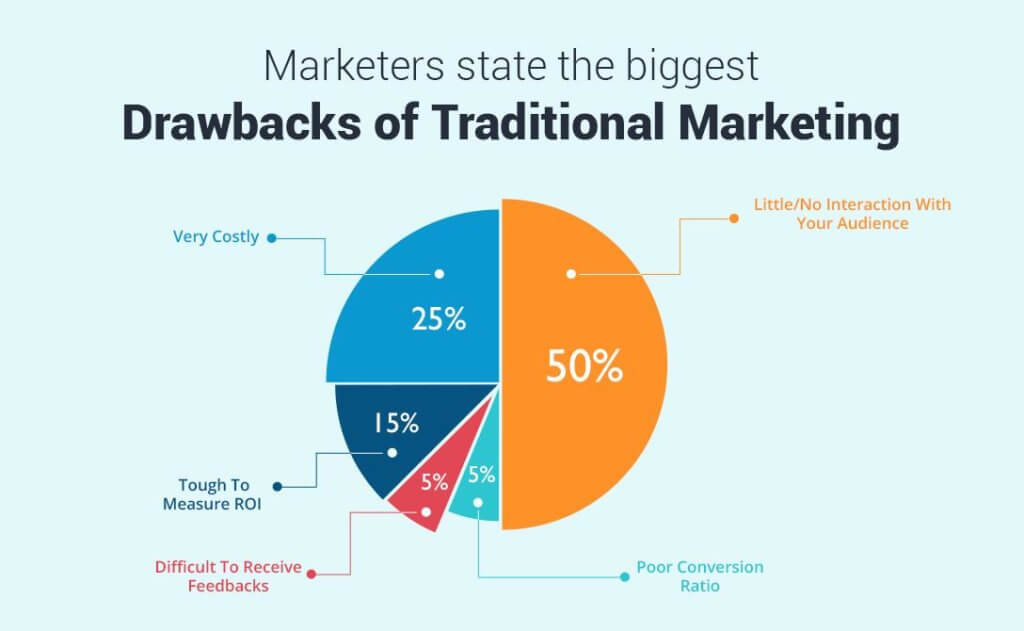
- Little Interaction
One of the biggest and the most obvious limitations of digital marketing is that there is little or no interaction between the customers and the medium used for marketing.
Traditional marketing is a one way street where a business is able to broadcast or provide information to their target audience about its product or service. This brand building exercise is done in the hope to attract the attention of the right people and maybe convert them into customers.
- No Control Over Timing
Traditional marketing is dependent on promotional methods that once executed cannot be updated. Whether it is a static text print ad in your local newspaper or a television commercial, you will have to place a new ad to replace the old one in case of any change. While this may not seem like a huge factor, but it does make a big difference in the long run.
For instance, let’s say you run a magazine ad promoting your latest widget. After which, you make a major update to it that can make a significant impact to the sales numbers. Can you change the ad on fly? Of course not, which can put a huge dent in your marketing budget overtime.
- Higher Costs
The recurring costs in traditional marketing can prove to be a huge investment that may or may not give a good return. Your ad in the local newspaper will only be effective if it is seen by your target audience on the day it gets published. And what are your chances of that?
If you want to reach out to them again, you need to create and run a new print ad campaign. Or when you create and distribute posters or fliers in your area, it’s an investment you are making for a one time exposure. Compare that to content that you create on your website that can bring in target visitors for years to come at no additional cost.
- Limited Customization Options
Do you want to target customers working in a certain industry and fall in particular age group? Traditional marketing offers you little help when it comes to customizing your campaign and targeting a specific customers.
Even though you can use traditional marketing techniques to market to certain segments, you cannot go after targeted customers. When you’re using online ads, you have the option to not only reach out to the right kind of customers, but also show them offers that are tailored towards them.
- Inability to Disclose Full Pricing Details
At the basic level, traditional marketing has never failed to attract people based on discounted prices or special sales. However, when it comes down to offering more unique, customized pricing options, you may hit a brick wall. If you analyze the options given to you in print marketing, you may not find the needed space to display all your pricing options – even though these can help you convert more people into customers.
- Poor Campaign Measurement
When executing a traditional marketing strategy, it is essential to know how effective it is to ensure you’re not investing in the wrong direction. Unfortunately, results that you get from traditional marketing cannot be measured easily and efficiently.
However, when you launch an online marketing campaign, you can effortlessly identify where you are going wrong and if it is successful or not. This alone makes digital marketing much better than its traditional counterpart.
Digital Marketing vs Traditional Marketing: What is Digital?
Digital marketing or online marketing refers to the marketed related work that a business does through the Internet or an electronic device such as a mobile phone. Any business (regardless of its size) can leverage digital marketing to reach out to their target market, connect with prospects and convert more of them into customers/clients. Everything from search engine marketing to Facebook marketing comes under digital marketing. And we offer an array of digital marketing services here at LYFE. Feel free to check them out and see which ones might be best for your business.
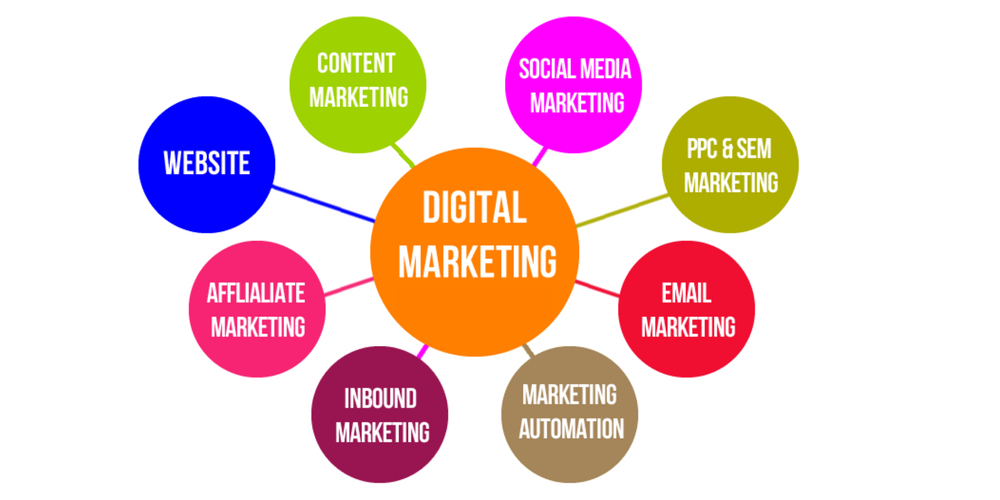 The reason why digital marketing is crucial for a business today is because the Internet is becoming one of the most used tools. More and more people are logging on the web to carry out their day to day activities, which includes purchasing goods and services.
If you look at the past decade you’ll see that online marketing has grown exponentially. So when it comes to digital marketing vs traditional marketing, it’s clear that that digital as a definite edge.
Successful marketing requires a business to connect to prospects and customers in the best possible way, so that their is an actual return on the investment. Given the fact that a large majority of people (especially theMillenials) are spending their time on the Internet, it makes sense for you, as a business, to connect to them on it.
As technology grows and the new digital ideas are brought to life, the digital marketing world grows with it. One of the reasons why it continues to deliver results is because it is a form of inbound marketing. Which means, instead of you going out there to find people, they find you. Whether it is running an advertisement on Google or creating marketing related content for your blog, it’s all about attracting your target audience and spreading awareness.
The idea is to get out there and gain exposure. Because the more people know about your website, your brand and the products you sell, the more familiar they become with your agenda. Which eventually leads to close relationships or bonding that is developed on the basis of trust.
Being a business, the Internet offers you a way to build an authority in your niche and grow your online presence like never before.
Digital Marketing vs Traditional Marketing: What Do the Stats Say?
Keeping the current growth of digital marketing in mind, particularly in the U.S., it won’t be long before digital ad spend takes over traditional advertising such as television ads. As of today, 60% of marketers across various industries have already shifted their efforts towards digital marketing.
Here are some more stats to help you understand the growth and prominence of digital marketing…
- More than 80% of shoppers/buyers do their research online before investing in a product/service.
- Almost 60% of U.S. adults use Facebook on a regular basis.
- 94% of B2B marketers are actively using LinkedIn for marketing.
- Mobile will be accounting for over 70% of digital ad spend by 2019.
- 90% B2C businesses report social media as being the most effective content marketing tactic.
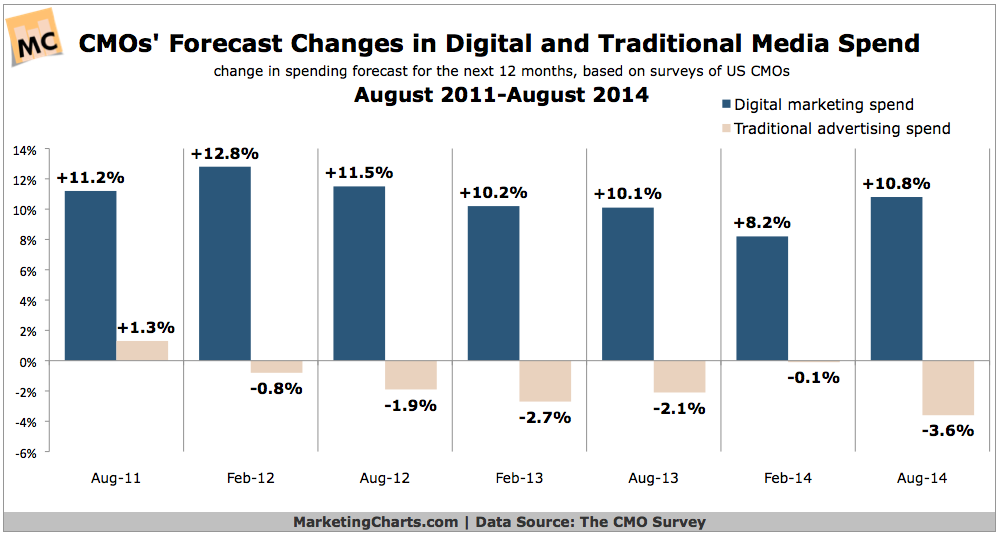
Regardless of the business you are in, you need to take theimportance of digital marketinginto consideration. Or else you may lose out to competition that is taking advantage of the latest digital marketing techniques.
Now, truly understanding digital marketing trends and applying methods that are suitable for your business may not be your specialty. It may take a considerable amount of time and investment to see favorable results. In such a scenario, working with a specialized digital marketing agency like ours can help you get a high return on investment. Contact us if you’d like to discuss your digital marketing campaign.
Digital Marketing vs Traditional Marketing: Where to Invest?
Setting a marketing budget is one thing, but making sure you get a good return on your investment is something else. Which is why it makes sense to focus only on those marketing channels and methods that are more likely to give you the best bang for your buck.
The digital marketing vs traditional marketing debate is age old, and it’s far from over. However, given the advancement in technology, there is no denying the fact that digital marketing can help a business generate qualified leads/sales without putting a dent in the wallet. The risk is definitely smaller when compared to traditional marketing.
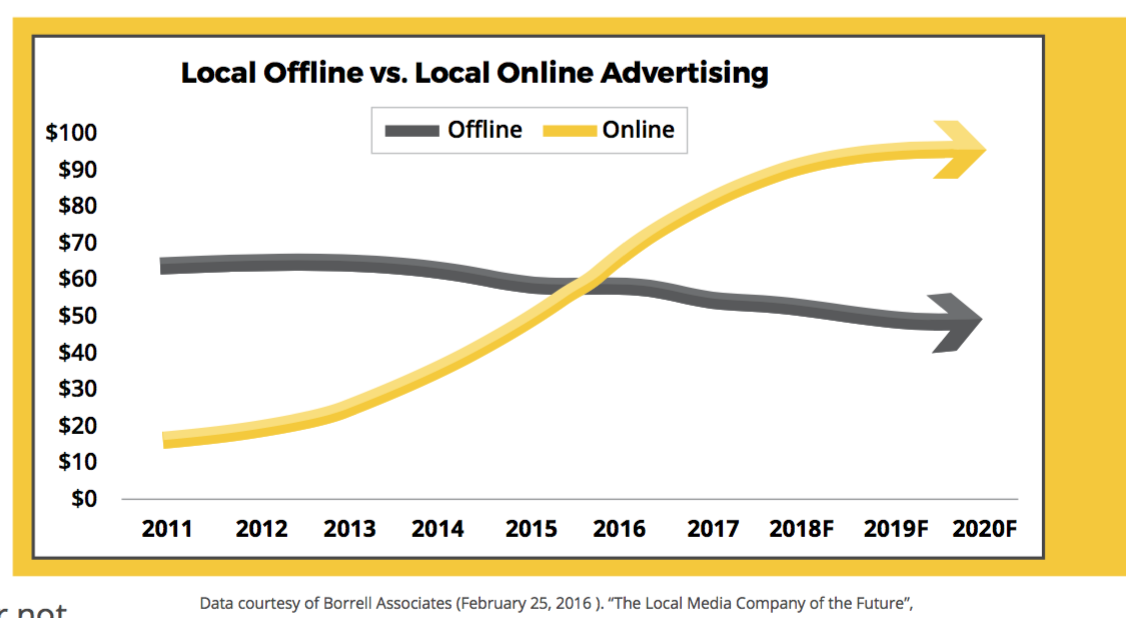
If you look around, you’ll find businesses of all sizes taking advantage of digital marketing, especially because of the lower cost/barrier to entry when compared to offline marketing methods such as print advertising. Even though print ads can help in brand building, digital marketing can assist a company in building a strong foundation for effective promotion. And it can be done with a much smaller budget.
Investing in Print Ads
There’s no doubt that print ads can work great if done properly. However, without consistency, print advertising will fail to give favorable results. Whether you choose to advertise in a major magazine or your local newspaper, you need to be ready to spend huge money over a long period of time.
Here’s what the results looked like when Blue Fountain Media decided to advertise with a major magazine.
 Also, when it comes to print ads, what many businesses fail to understand is the circulation aspect. The number of readers who actually see your ad will be less than the number of magazines in circulation. Because a good percentage of magazine issues will almost always go unsold.
Investing in Digital Ads
Digital ads are more customizable than print ads, which makes them less risky. For instance, if you are running a search campaign, you can target your ad to a certain audience and change it later on. Making adjustments and tweaking your ads according to real-time data is simply easier.
Then comes the question of CPM, which can be pricey with magazine ads. According to Gaebler, a full page (black and white) ad costs close to $120k, for a CPM of $50 USD. Compare this to a digital marketing channel such as Google Display Ads, where you are charged per click, rather than per impression. Which means CPM can in some cases cost you zero dollars. So if you are a business with a limited budget and want to increase your chances of success, digital marketing may be your best bet.
 Looking at the above example, Blue Fountain Media found a clear winner in digital advertising as the magazine ad proved to be costlier. This just goes on to show that the level of customization and tracking you get with digital marketing is above part. You have a lot more control over the ad’s performance and in-depth analytics to improve them along the way.
Digital Marketing vs Traditional Marketing: Why Choose Digital
For some brands, especially the well-established ones with a huge offline audience, traditional marketing may be too expensive to ignore. But for the many small businesses that are trying to make a mark on a tight budget, digital marketing can prove to be a savior. Which is why many new and old businesses are leveraging the power of digital marketing and rethinking the marketing funnel.

#1: Higher Level of Customer Engagement
Traditional marketing doesn’t allow direct interaction with customers, whereas digital marketing offers a higher level of engagement and interaction. Whether it is through social media comments or email messages, your target audience is instantly connected with you through various digital marketing channels. Your brand can also easily build better and long lasting relationships with customers by interacting with them via video, surveys or webinars. Your business performs better when it runs in conjunction with the requirements of your customers. And digital marketing lets you do that as you can engage with customers and solve their issues/problems without wasting time.
Your brand can also easily build better and long lasting relationships with customers by interacting with them via video, surveys or webinars. Your business performs better when it runs in conjunction with the requirements of your customers. And digital marketing lets you do that as you can engage with customers and solve their issues/problems without wasting time.

#2: Ease of Measuring Results
When you give away brochures, distribute fliers or advertise in magazines, you don’t know how far your marketing is going to be successful. You may be headed in the wrong direction, but there’s no way to tell.
Unlike traditional marketing, digital marketing lets you measure results. It allows you to play a clear-sighted marketing game, rather than a blind one. You have access to a ton a information about your prospects and customers to help you understand where you are going. Right from how many people are visiting/leaving your website to what percentage of them are converting. Imagine the level of tweaking/testing you can do with digital marketing, which is literally absent in traditional marketing.
You have access to a ton a information about your prospects and customers to help you understand where you are going. Right from how many people are visiting/leaving your website to what percentage of them are converting. Imagine the level of tweaking/testing you can do with digital marketing, which is literally absent in traditional marketing.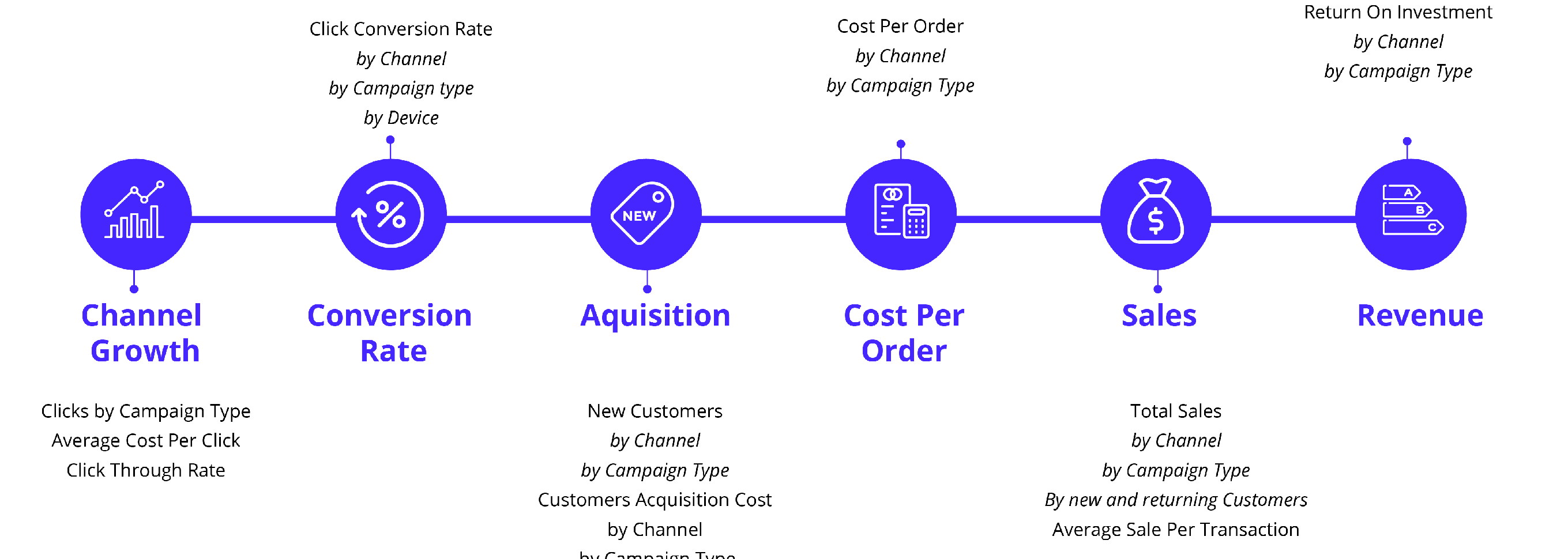
#3: Bigger Audience Range
Traditional marketing is limited in many ways, but one of the biggest restriction that comes with it is the inability to go beyond a regional or local audience. Your business may not be geographically-bound, so why limit your reach? Using digital marketing, you can create a highly customized campaign and widen your reach to different cities or even different countries. So say goodbye to the blanket approach that traditional marketing takes and say hello to digital marketing that lets you alter your campaign based on how far you want to go.
Using digital marketing, you can create a highly customized campaign and widen your reach to different cities or even different countries. So say goodbye to the blanket approach that traditional marketing takes and say hello to digital marketing that lets you alter your campaign based on how far you want to go.

#4: Less Expensive & More Effective
When it comes to spending money on marketing, your return on investment decides whether your campaign was successful or not. There’s no surprise that digital marketing fetches you a better ROI because it’s cheaper than traditional marketing/advertising in more than one way.Would you rather invest in an advertisement where you pay based on performance or in a costly newspaper ad that is seen by a limited audience? Digital marketing allows you to spend less while gaining more. For many businesses, it’s a no brainer.
Would you rather invest in an advertisement where you pay based on performance or in a costly newspaper ad that is seen by a limited audience? Digital marketing allows you to spend less while gaining more. For many businesses, it’s a no brainer.
Decision Time: Digital Marketing vs Traditional Marketing
We would hope we’ve convinced you with data and facts that digital marketing is definitely the way to advertise as a small business. If you’ve already tried traditional marketing before and haven’t seen the rapid growth results you wanted, then give digital marketing a shot. There is little risk and great reward. That’s not a combo you see often in the business world.
Our experts can even take off a little of the pressure. They do all the work for you. All you have to do is stay informed and approve material. At LYFE Marketing, we take the worry out your online advertising and digital marketing which allows you to focus on other areas of business that need your undivided attention. today to start your digital marketing campaign. It’s that simple.

 AutoInfo